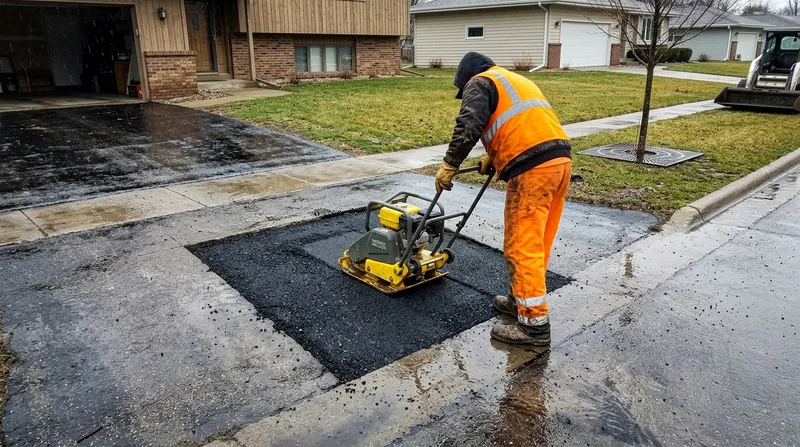




Cedar Rapids and the surrounding Iowa Corridor sit on wind-blown loess over glacial till clay, with Cedar Valley limestone close to the surface. Winter brings dozens of freeze-thaw cycles from December through March, and road salt chews edges fast. The result is pothole repair and asphalt patching that becomes urgent every spring as the pavement fails section by section. Whether your driveway is in the historic neighborhoods around Coe College, the 1950s-80s ranches on the northeast and northwest sides, or the newer subdivisions spreading through Marion, Hiawatha, Robins, and North Liberty, freeze-thaw damage hits the same way: water works into cracks, expands when it freezes, and pops the surface open. We cut potholes square, tack-coat the edges, and fill them with compacted hot mix. We also run infrared patching that recycles the surface in place for seamless repairs with no waiting. The difference between a quick patch that holds and money thrown away is getting the work done before one hole becomes a failed section.
Why Pothole Repair Matters in Cedar Rapids: Winter Damage Accelerates Fast
The freeze-thaw cycle that dominates Iowa winters opens potholes faster than most homeowners expect. Water enters through existing cracks, freezes and expands, and breaks the bond between the asphalt and the base below. One pothole left unrepaired becomes two, then a section of failed pavement. On residential drives in the Oakhill Jackson neighborhood or the blocks around Wellington Heights, a single season of neglect can turn a patch job into a full resurfacing. On commercial parking lots along Collins Road and Edgewood Road, a pothole can damage a vehicle and create liability. The cost to repair one pothole now is a fraction of the cost to resurface the entire drive later.
- Freeze-thaw cycles in Cedar Rapids typically run from December through March, with the most aggressive damage occurring in late winter and early spring.
- Water intrusion through small cracks accelerates the failure of the asphalt layer and the base below it.
- Early repair prevents the spread of damage to surrounding pavement and keeps repair costs manageable.
- Parking lots and high-traffic driveways are most vulnerable because they carry load and concentrate stress at weak points.
- A written estimate with tonnage and thickness specifications protects you and ensures the repair is built to last.
Early assessment in late winter or early spring catches damage before it spreads. We book quick evaluations so one hole does not become a failed section.
Key info: The Cedar Rapids freeze-thaw season typically runs December through March, with the most aggressive pothole formation occurring in February and March as freeze cycles intensify and snow melt works into cracks. A late-winter assessment prevents expensive spring repairs.
For more context on how freeze-thaw damage affects your entire driveway and when to consider larger repair options, see our guide to driveway repair in Cedar Rapids.
How Pothole Repair and Patching Work: Two Methods for Cedar Rapids Driveways
We use two proven approaches depending on the size, location, and condition of the pothole. Traditional square-cut patching is the standard for isolated holes and works well on most residential and commercial drives. Infrared patching recycles the surface in place and creates a seamless repair with no cold joints. Both methods start with assessment: we measure the hole, check the base, and determine whether the surrounding pavement is sound enough to hold the patch or whether the damage signals a larger resurfacing need.
- We excavate the damaged area to a square or rectangular edge, removing all failed asphalt and loose material down to solid base.
- The edges are cleaned and tack-coated with adhesive to bond the new material to the existing pavement.
- We place and compact hot mix asphalt in lifts, finishing flush with the surrounding surface.
- Infrared patching heats the existing asphalt in place, blends new material into it, and compacts everything as one unified layer with no seam.
- Both methods cure as the material cools, and the drive is ready for normal traffic within hours.
The choice between methods depends on the pothole size, the surrounding pavement condition, and whether you want a visible repair or a seamless blend. We assess on site and recommend the approach that will hold longest and cost least.
Real example: A Wellington Heights homeowner called in late February with three potholes across the lower half of her driveway. The rest of the drive was sound. We square-cut and patched all three in one afternoon, tack-coated each edge, and compacted the hot mix. The patches held through the rest of winter and into the following season. Had she waited until April, the freeze cycles would have opened more holes and turned the job into a full resurfacing.
If your driveway shows widespread cracking or multiple patches spreading across large sections, asphalt resurfacing and overlay may be more cost-effective than patching.
Pothole Repair and Asphalt Patching Methods
| Approach | Description | Best for |
|---|---|---|
| Square-Cut Patching | We excavate the damaged area to clean edges, tack-coat, and fill with compacted hot mix asphalt finished flush with the surface. | Single or isolated potholes, residential driveways, parking lot repairs where speed and cost matter. |
| Infrared Patching | We heat the existing asphalt in place, blend new material into it, and compact everything as one unified layer with no seam or cold joint. | Seamless appearance, areas where future cracking at the patch edge is a concern, high-traffic sections where bonding matters. |
| Multiple Patches on Sound Base | We repair two to five potholes across a driveway or lot that is otherwise structurally sound, using square-cut or infrared as appropriate. | Driveways with freeze-thaw damage concentrated in specific areas, parking lots after a harsh winter, drives not yet ready for full resurfacing. |
| Assessment and Recommendation | We measure the pothole, check the base and surrounding pavement, and recommend patching or resurfacing based on what will hold longest and cost least. | Any homeowner or property manager unsure whether a pothole is an isolated repair or a sign of larger failure. |
Pothole Repair and Asphalt Patching Cost in Cedar Rapids: What to Expect
Pothole repair starts at around $450 for a single isolated hole on a residential driveway. That figure covers excavation, cleaning, tack-coat, and compacted hot mix fill on a pothole roughly 2 feet by 2 feet by 4 inches deep. The actual cost depends on the size of the damaged area, the depth and condition of the base below, whether surrounding pavement is sound or also failing, and the access for equipment. A pothole in the middle of a wide parking lot costs less per square foot than a hole in a tight residential drive where we must work around parked cars or narrow aprons. Multiple potholes on the same property typically reduce the per-hole cost because we are already mobilized and set up.
- Single isolated potholes on residential drives typically run $450 to $750 depending on size and base condition.
- Multiple potholes on the same property benefit from economies of scale and usually cost less per hole than a single repair.
- Infrared patching typically costs 20 to 30 percent more than square-cut patching because of equipment and material, but creates a seamless repair with no visible seam.
- Large or deep potholes that expose poor base material may require base repair or replacement, which adds to the estimate.
- Every estimate includes measurement, depth check, and a written specification of what material and thickness will be used.
Getting 2 or 3 estimates is smart because repair quality varies. Verify that the estimate includes tonnage, compaction specification, and a tack-coat step. For detailed pricing on larger jobs or resurfacing options, see our full pricing overview.
What to Look for When Hiring a Paving Contractor for Pothole Repair Near Me in Cedar Rapids
Choosing a contractor for pothole repair and patching is straightforward if you know what to verify. Start by confirming that the contractor is fully insured and can provide a certificate of insurance. Ask for a written estimate that includes the size of the repair, the depth, the tonnage of material, and the compaction specification. Get multiple estimates and compare them side by side. A price that seems too good is usually a sign that material or compaction is being skipped. Avoid any contractor offering an unsolicited door-to-door estimate with no written contract, a large cash deposit, or out-of-state plates. A local contractor with a local address and local business roots is the strongest trust signal in this trade.
- Verify that the contractor is fully insured and ask to see a current certificate of insurance before work begins.
- Request a written estimate that specifies the repair size, base depth, tonnage of hot mix, and compaction method.
- Get 2 or 3 estimates from different contractors and compare the material specifications, not just the price.
- Check references from recent work in Cedar Rapids, Marion, Hiawatha, or nearby towns to confirm the contractor stands behind the repair.
- Ask about the warranty on the work itself, which is typically 1 to 3 years on installation quality, never a lifetime warranty on the material.
- If your driveway is in an HOA community or a historic district, verify that any apron extension or widening meets local architectural standards before you commit.
A contractor who takes time to explain the problem, recommends patching when patching will hold, and proposes resurfacing or replacement only when the damage justifies it is someone you can trust. Contact us for a free estimate and assessment at our contact page or call (319) 403-3885.
Pothole Repair & Asphalt Patching in Cedar Rapids: Pricing Guide
| Service | Price | Details |
|---|---|---|
| Single Pothole Repair | Starting at $450 | Square-cut excavation, tack-coat, and compacted hot mix fill for one isolated pothole up to 2 feet by 2 feet by 4 inches deep |
| Multiple Potholes (2-5 on Same Property) | Starting at $350 per hole | Discounted per-hole rate when we are already mobilized; includes excavation, tack-coat, and compacted hot mix for each repair |
| Infrared Patching (Seamless) | Starting at $600 | Heats existing asphalt in place and blends new material for a unified, seamless repair with no visible cold joint or seam |
| Base Repair or Replacement | On estimate | If the pothole exposes failed or soft base material, additional excavation and base preparation may be required; site assessment determines scope |
| Travel and Mobilization | Included | No separate mileage or call-out fee for Cedar Rapids and surrounding service areas within the Iowa Corridor |
| Free Estimate | No cost | Written estimate with measurement, depth check, and material specification; response within 24 hours at (319) 403-3885 |
Indicative pricing, the exact cost depends on square footage, finish, and site access. Free personalized estimate within 24h at (319) 403-3885.


